
The Origin of Pocong
The belief in the Pocong (pronounced poh-chong, not poh-kong) reflects a convergence of animistic traditions and Islamic burial practices. Central to this belief is the notion that the knots securing a burial shroud must be loosened to release the soul of the deceased, as leaving them tied may cause the dead to return as a shrouded spirit. This belief highlights the cultural and spiritual significance of proper funerary rites among certain Malay and Indonesian Muslim communities. Although both communities recognise a similar folkloric entity, they historically used different names to identify it.

The significance of these naming distinctions becomes particularly apparent in contemporary media, where culturally specific names may lose their original meanings through translation. In the 2024 Indonesian horror film Do You See What I See, which centres on a forbidden romance between a female college student and a Pocong, the English subtitles render the name Pocong as demon and corpse. However, these English words correspond to iblis/setan and mayat, respectively, in Indonesian, neither of which preserves the specific cultural identity conveyed by the name Pocong.
Such translations, which demonstrate considerable generalisation and semantic distortion, have prompted me to revisit a longstanding question concerning the historical origins of the name Pocong.
Hantu Bungkus in History
An early description of this folkloric figure appears in a 1903 anthropological report by Nelson Annandale1, based on his expedition to Perak and the Siamese Malay States. He recorded the names Hantu Bungkus and Hantu Galas2, translating them as Bundle or Package Spirit3. The report describes two forms of the same entity: a bundle of dirty white rags and, curiously, a white cat.
Annandale described the entity as one of the most dreaded of spirits in Pattani, elaborating that the bundle lies about at night in lanes leading to the cemetery. When a frightened person passes by, it unrolls itself, twines itself round his feet, enters his person by means of his big toe, and feasts within on his soul, so that he becomes distraught and dies in convulsions, unless a competent medicine-man can exorcise it in time to save his life and reason.

Pattani’s location in southern Thailand, near the Malaysian border, raises the possibility that Annandale conflated distinct local beliefs and amalgamated two different entities into one. The name Hantu Galas, also recorded by him as Bantu Galas, appears to be unattested in other sources. Its one-letter difference from Galah suggests a possible typesetting error for the Malay Hantu Galah, which has a parallel in the Thai Phi Taan Hua Khao.
The manifestation as a white cat introduces a separate inconsistency, given its association with good fortune in some Thai traditions, contrasting with Annandale’s depiction of a dreaded spirit. These discrepancies raise the possibility that his account combined elements of different folkloric traditions. Regardless of my hypothesis, Hantu Bungkus and Pocong are most certainly one and the same.
Malay Naming Convention and Colloquial Names
The names of Malay folkloric figures commonly follow a naming convention in which the class term Hantu, meaning spirit or ghost, is combined with a word describing the entity’s appearance or behaviour. In his 1903 anthropological report, Annandale cited a very intelligent Malay from Upper Perak who described Hantu Bungkus as a corpse wrapped in its shroud. However, his report does not mention other colloquial names, such as Hantu Golek, Hantu Bantal, Hantu Bangkit, Hantu Gula-gula, and particularly Hantu Guling and Hantu Gulung, both of which had been recorded before 1903.
Based on Richard James Wilkinson’s Malay-English dictionaries4, the word Bangkit, meaning to rise and stand or erected, refers to the reanimation of the dead. Several terms describe its movement: Golek means easily swaying, easily shaken, or rolled; Guling, functioning as a verb in Malay and Indonesian, means rolling, revolving, rolling over, or roll about; and Gulung denotes to roll up or rolling up. Other names refer to the shape of the shrouded body. Gula-gula, meaning sweets, resembles twist-wrapped confectionery, while bungkus refers to the wrapping of a package or parcel. Similarly, bantal, meaning cushion or pillow, can also denote a bolster, a meaning shared by guling in Indonesian.
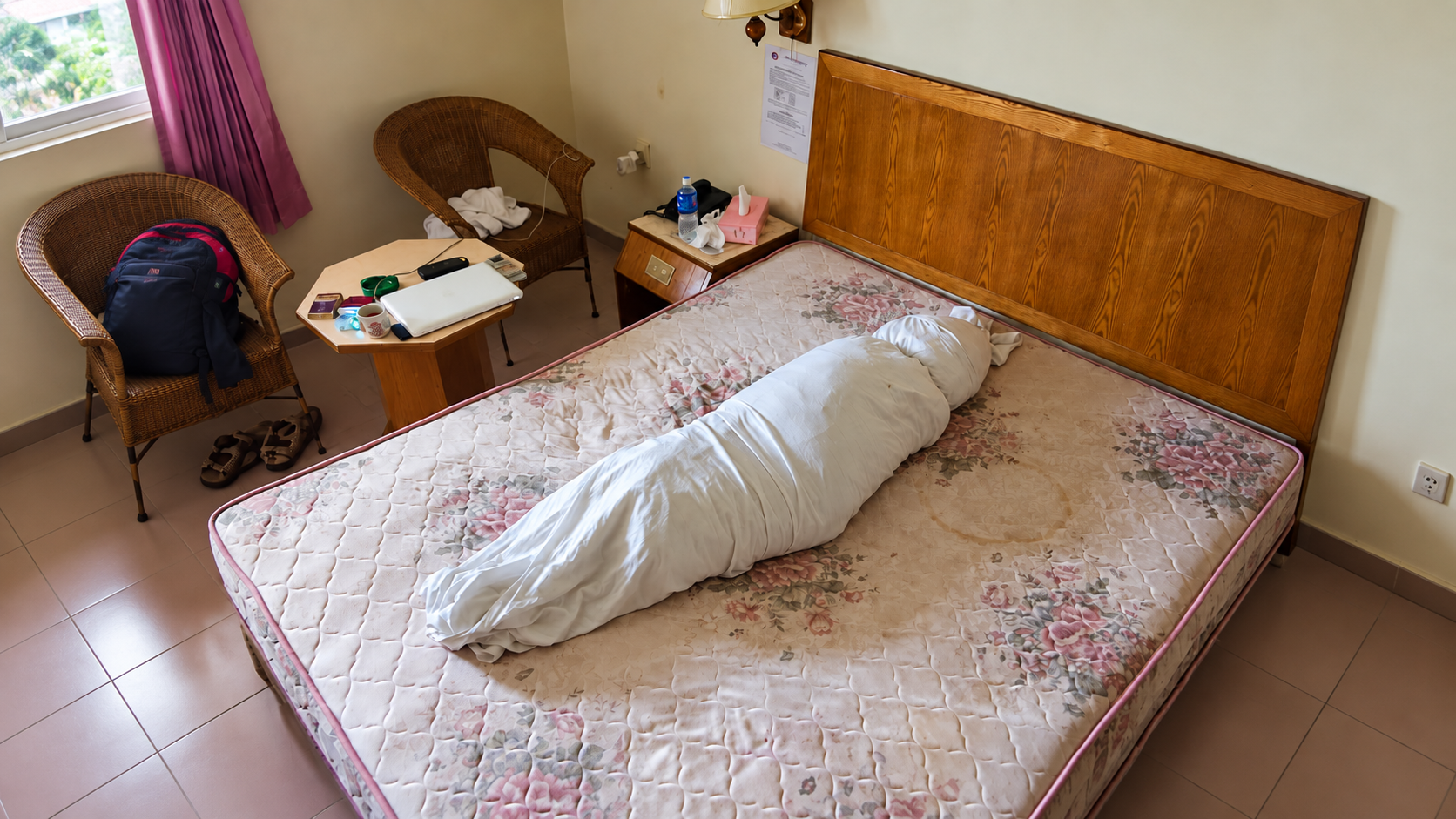
This is not a real ghost caught on camera. Ghost don’t exist.
Wilkinson’s dictionaries also contain Malay dialect words and Javanese terms, the latter identified by the abbreviation jav. Curiously, neither the modern Pocong nor its pre-1950 variant, Pochong, appears as an entry. The closest phonetic resemblance is puchong, a general term for bitterns, including Dupetor flavicollis, Ardetta cinnamomea, Ardetta sinensis, and Butorides javanica.
This raises an important question: Did the word Pocong emerge in Malay usage only in the latter half of the twentieth century, or is there something about the name that remains largely unknown?
Hantu Kochong in History
In her 2012 encyclopaedia5, Theresa Bane listed Hantu Kochong as another name for Hantu Bungkus. Curious about how far back the name could be traced, I rummaged through older records and found it in the 1932 Journal of the Malayan Branch of the Royal Asiatic Society, Vol. 10, where it appeared as Hantu Kochong (“sheeted ghost”).
Looking further back, I came across Wilkinson’s 1908 dictionary, in which he defined kochong as a long pyramidal cap; hantu k., a sheeted ghost which progresses over the ground by rolling along sideways. However, Wilkinson had already recorded Hantu Kochong two years earlier, in his 1906 Malay Beliefs6, published three years after Annandale’s Fasciculi Malayenses in 1903. These records establish that Kochong was an early spelling of Pocong.
The absence of Hantu Kochong from Annandale’s report does not mean the name was unknown elsewhere. Language varies across regions and communities, and even people who speak the same language may use different names for the same thing. English is one example, with vocabulary differing between countries and communities. This is particularly relevant in Southeast Asia, where ethnic, linguistic and religious diversity has shaped local traditions, including the names given to figures in folklore. Hantu Kochong and Hantu Bungkus may therefore have been used concurrently in different areas.
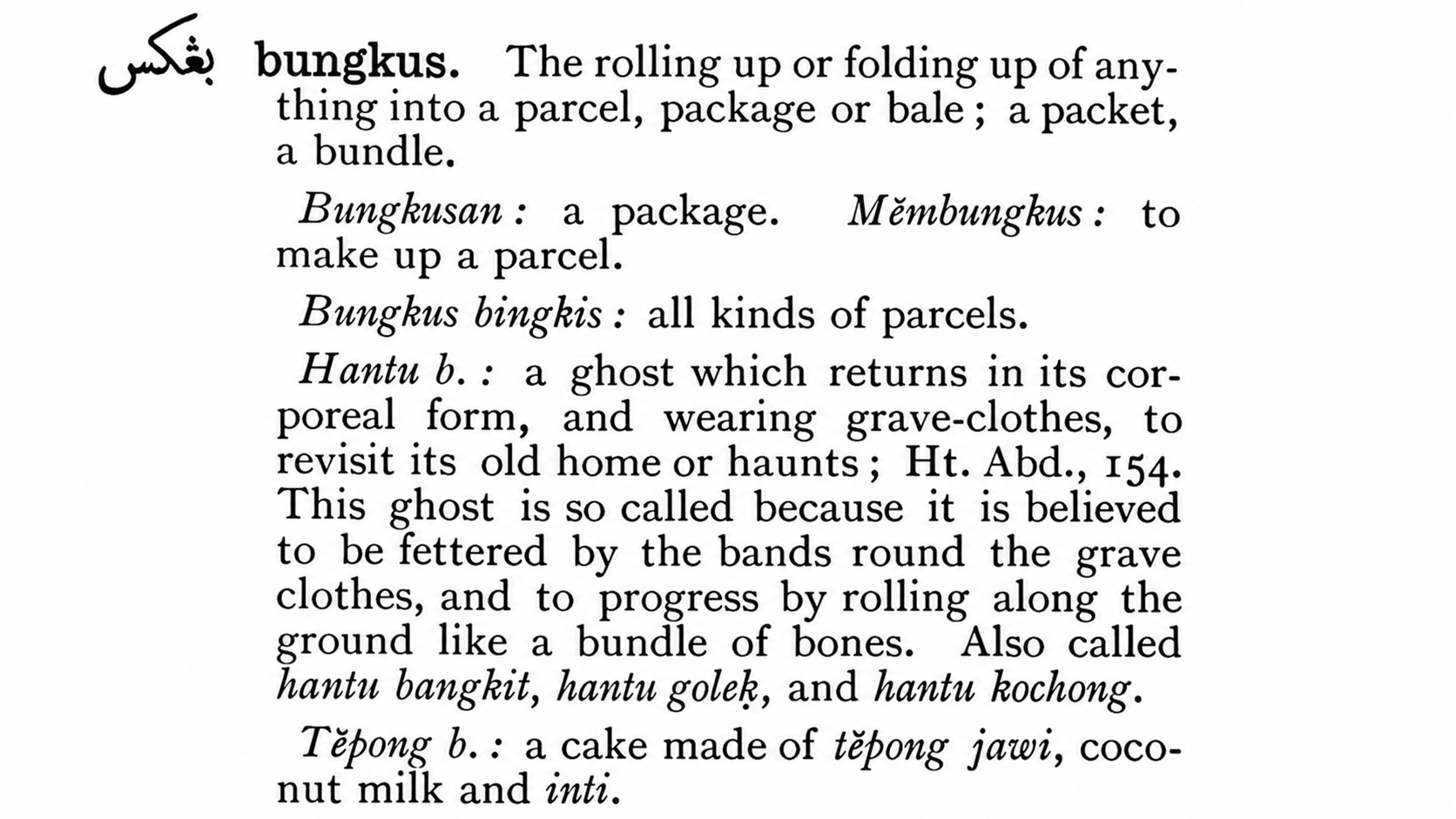
Tracing the records further back led me to Wilkinson’s 1901 Malay–English dictionary, where a single entry under bungkus lists four names together: Hantu Bungkus, Hantu Bangkit, Hantu Golek, and Hantu Kochong. It is worth noting that Walter William Skeat, in his 1900 Malay Magic, used kochong to describe the tying of a burial shroud’s ends with strips torn from the cloth7. He, however, did not explicitly use the term as a name.
Wilkinson cites Hikayat Abdullah (Ht. Abd) in his 1901 entry, but I could not trace the exact reference. However, I found the name Hantu Bungkus in Kassim Ahmad’s 1970 edition of The Hikayat Abdullah8. Due to limited resources, I could not verify whether the name also appeared in the 1849 Jawi printing of Hikayat Abdullah (حکایت عبدالله) by Abdullah bin Abdul Kadir9. Its appearance in the 1970 edition does not necessarily establish its presence in the 1849 printing. If the name was indeed present in that earlier edition, it would predate the other recorded names I have traced so far.
The Origin of Pocong
The word kocong appears in Indonesian, where it is defined as hood, with related meanings including kap (cap), tenda (tent), tudung (veil), kap mobil (car bonnet) and penjahat (a hooded villain). These meanings share the idea of covering or enclosure, which also relates to the appearance of a shrouded corpse. Similarities can also be found in food names. Kelupis, a traditional leaf-wrapped glutinous rice snack, is sometimes called Kochong, with one variation folded into a triangular shape resembling a hood10. Wilkinson also links kochong to konchong, a name for a type of pork sausage11, similar in shape to the Chinese sausage known in Cantonese as lap cheong. Such comparisons bring to mind Malay folklore names like Hantu Bantal and Hantu Gula-gula, which refer to familiar shapes.
16 November 2014
Although Malay has borrowed words from Javanese, Chinese, Tamil, Dutch, French and other languages, I could not establish whether kochong originated in Malay or was borrowed from Javanese, Sundanese or another language spoken in Java. Wilkinson also did not mark kochong as jav. in his dictionary.
However, there are two possible connections between Kachong and Javanese. The first concerns the difference between the initial K in Kachong and P in Pocong, with the former possibly indicating a Javanese origin. A similar distinction appears between Kuntilanak and Pontianak. The name Kuntilanak may have emerged through Hindu-Javanese assimilation, possibly deriving from Bhattari Kunti, the Javanese adaptation of Kuntī, mother of the Pandavas in the Indian Mahābhārata. Hindu-Javanese traditions may have influenced local beliefs about female spirits, particularly those associated with motherhood. It is also worth noting that the interpretation of Pontianak as Perempuan Mati Anak is a modern Malay interpretation, while the name itself was not originally Malay.
The second connection concerns differences in Malay and Javanese naming conventions. As discussed earlier, Malay generally uses Hantu as a class term, while Javanese folkloric figures are often known by names without this classification. Examples include Javanese Genderuwo and Malay Orang Mawas, Kuntilanak and Hantu Pontianak, Wewe Gombel and Hantu Tetek, Kuyang and Hantu Penganggalan, and finally Kochong and Hantu Bungkus. Since Hantu is exclusively a Malay term, its addition to Kachong to form Hantu Kachong, which later evolved into Hantu Pocong before being shortened to Pocong, not only reflects the Malay naming convention but also suggests that Kachong/Pocong was not originally a Malay word.
Hikari D. Azyure, an urban explorer based in Singapore since 1995, is an independent researcher who has collaborated with others across academic and private sectors. His research centres on etymology and toponyms that may or may not be tied to folklore and mythology within the intangible cultural heritage field. The basis of this writing derived from a 4 July 2007 article Purpose of Pucong? That said, The Origin of Pocong is an original work by Urban Explorers of Singapore. Please cite/mention “Urban Explorers of Singapore” as the source if any of this material is used.
- Nelson Annandale. Fasciculi Malayenses: Anthropological and Zoological Results of an Expedition to Perak and the Siamese Malay States, 1901–1902. Vol. 1, 1903, pp. 21–22. ↩︎
- Annandale noted Bantu as a Malay word in his 1903 report, glossed as Independent Spirit, and listed it separately from the term Hantu. However, Wilkinson, in his 1901 and 1908 editions of the Malay-English Dictionary, glossed bantu as aid, assistance, to succour, to help. Bantu is a common word in Johor-Riau Malay. It is unclear whether the b- is a typesetting error, a metaphorical nuance of dialectal origin, or an initial consonant to the root antu, which parallels hantu in meaning. Despite the presence of bilmu (cf. ilmu, “knowledge”) and butan (cf. utan, “forest”), Annandale also wrote Bantu Bungkus even though Hantu Bungkus appeared elsewhere. I use Hantu in this writing to reflect a modern linguistic perspective. ↩︎
- It is unclear whether Annandale’s translation should be read as general or respective. Regardless, both still contradict Wilkinson’s definition of galas as “carrying on the back with a sling or support”. ↩︎
- Richard James Wilkinson. An Abridged Malay-English Dictionary (romanized). 1901, 1908, 1926 and 1961. ↩︎
- Theresa Bane. Encyclopedia of Demons in World Religions and Cultures. 2012, pp. 158-163. ↩︎
- Richard James Wilkinson. Malay Beliefs. 1906, p. 23. ↩︎
- Walter William Skeat. Malay magic: Being an introduction to the folklore and popular religion of the Malay Peninsula. 1900, p. 401 ↩︎
- Kassim Ahmad. The Hikayat Abdullah. 1970, p. 114 ↩︎
- Abdullah bin Abdul Kadir. Hikayat Abdullah (حکایت عبدالله). 1849. PDF via Sabrizain or Urban Explorers of Singapore’s GDrive ↩︎
- Search result for Kocong on Google Images. ↩︎
- Search result for Konchong on Google Images. ↩︎